Risk Assessment
Do you know the extent of loss you can stomach? Or is your plan to discover it in the middle of the crisis?
Most risk quizzes are measuring your mood
Your market perception at the time you take a quiz adds a tint to your results. Excess optimism or fear filters into your answers and you are left with results that do not match your temperment.
Typically quizzes slap the label “moderate” on someone, but what does that even mean? Two advisors can call the same household moderate and build portfolios that behave nothing alike, and neither of them is lying to you, there is just no definition sitting behind the word.
We take a multi-angle approach to understanding your risk tolerance and it helps to insulate your emotions when markets get rough.
Our quiz meets you where math and emotion find their balance
Willingness. What can you stomach?
When your account drops, what do you find yourself wanting to do? Stay the course or sell? We always attempt to imagine what we would do in different scenarios and it is always the most optimistic action that we assume we would take, which is famously wrong.
We are more likely to avoid loss than pursue pleasure, that is human nature. So we magnify the pain of loss and failure and we underscore success because we expect it, and our quiz sheds light on that truth.
Capacity. What can you afford?
Completely different question, and this one does not care how brave you feel.
This one is less emotion based and more mathematical. We dont have to convince ourselves of anything, numbers are truth. There is the rub though, we cannot twist them to fit our satisfaction.
Whichever number comes back lower is the one we use.
If you can stomach more than you can afford, you get what you can afford. We are not going to build you something that needs your nerve to hold in the same year your income might not.
What comes out of it
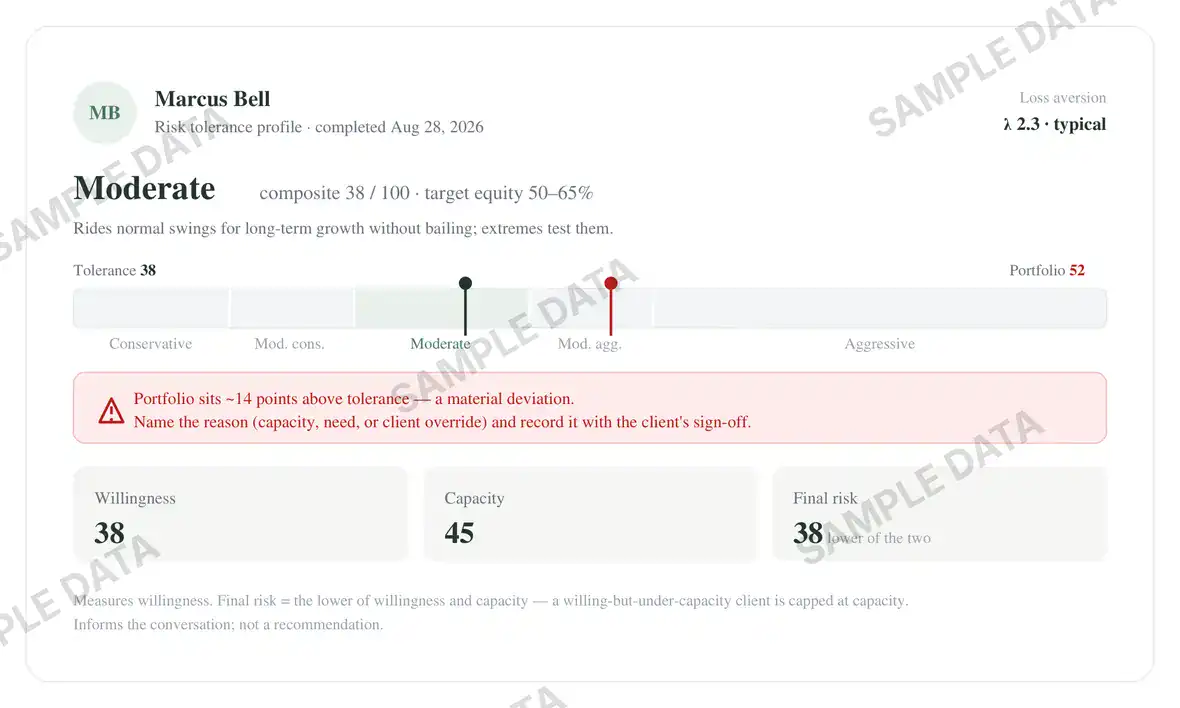
Sample data. A fictional household, shown to illustrate how the tool works.
A number out of 100, the band it falls in, and a target equity range attached to it. Both scores stay on the report so you can see which one capped you and by how much.
Loss aversion gets measured on its own and reported separately, because how hard you FEEL a loss and how much loss you can actually absorb are not the same trait and they do not always move together.
A fancy chart, cool. What does it mean?
Results mean nothing if we cannot understand their role in our action plan.
We score your tolerance alongside your portfolio. But we do so to make sure you never take on more than you can emotionally handle or physically afford.
So where does that number actually go?
Into the research side, which is where the portfolio gets built. This is the part most people never see, and it is the part where your score stops being a label and starts being a limit that something has to answer to.
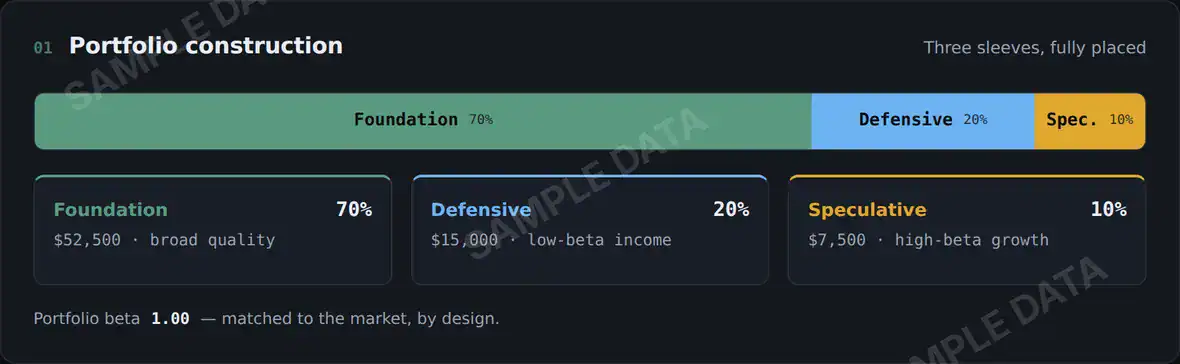
The portfolio gets built in sleeves. Foundation, defensive, and speculative, each one sized against what your profile allows. The speculative piece is not a gamble somebody took on your behalf, it is a budgeted portion, and your number sets the budget.
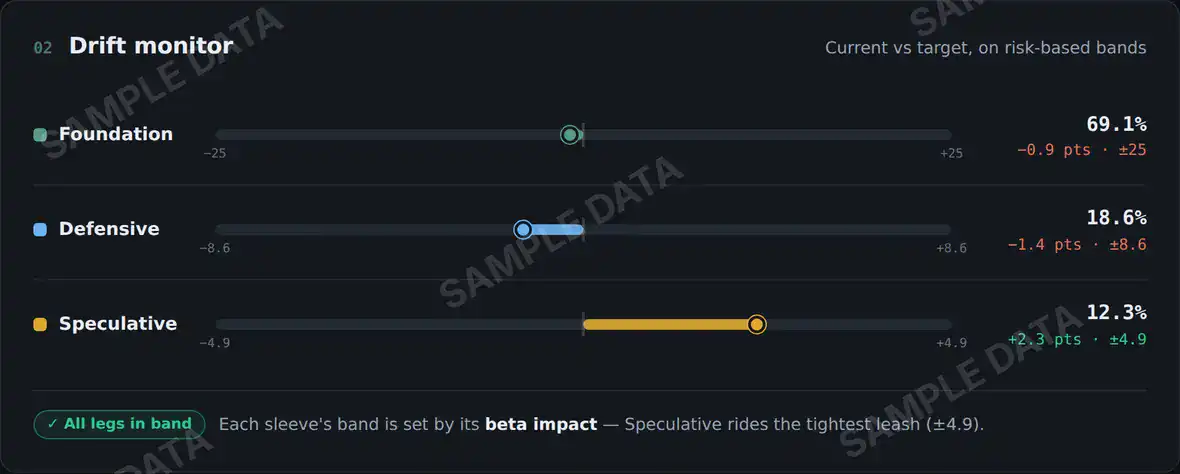
Then every sleeve gets a leash. The band is set by how much that sleeve moves the whole thing, which is why speculative rides the tightest one. When a leg wanders outside its band, it shows up here instead of waiting for somebody to stumble across it.
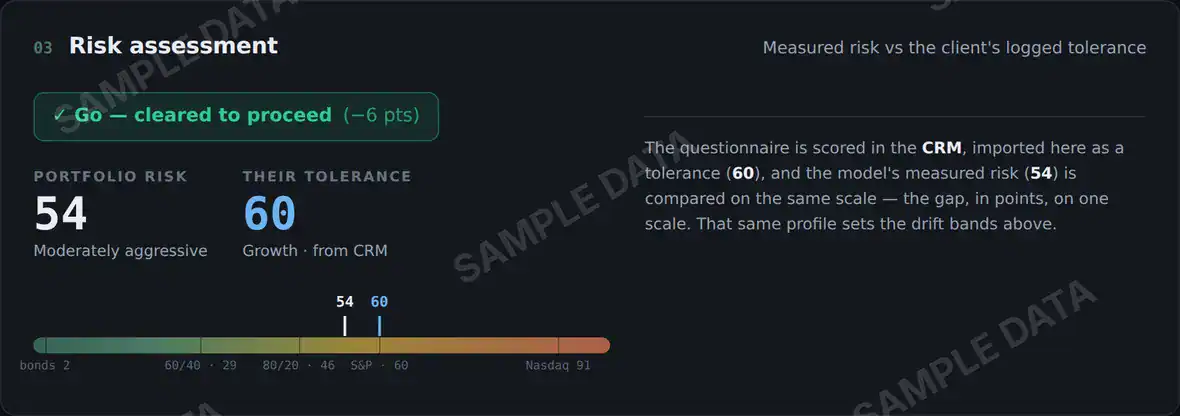
And this is where your two numbers meet. The portfolio gets measured on the same scale your tolerance sits on, and the gap is reported in points. No arguing about whether a word like moderate means the same thing to both of us.
Sample data. Fictional examples, shown to illustrate what the tools do.
What it needs from you
01
Honest answers, not brave ones
The only right answer is an honest one. Answering the way you wish you would behave will leave you abandoning a plan built for who you wish you could be.
02
How steady the income actually is
Income consistency directly impacts both your capacity and your willingness. It is reality, so lets not ignore it or downplay it.
03
When you need the money
The date circled on your calendar that you plan to take action by. We need a deadline to target and not just wishes and hopes.
04
What is already set aside
Reserves move capacity further than people expect. Somebody with six months of expenses in cash can carry a lot more volatility than somebody with none, same income, same everything else.
Where this sits in the bigger picture
This is the first step, because everything after it gets measured against this number.
Start here
Know your number
Then
Set your boundaries
Then
Build the portfolio
Ongoing
Check the drift
Skip it and the allocation is a guess that happens to have your money in it.
Questions people ask
Is there a right answer?
No, and there is nothing to score well on. The questions are built so that answering the way you wish you would behave gives you a portfolio you will bail out of the first time it gets tested.
What if my two scores are far apart?
Happens constantly and it is useful when it does. A wide gap between willingness and capacity usually points at something specific, an unsteady income, a short horizon, thin reserves, etc. The gap itself is worth a conversation.
Can I retake it?
Yes, and you should when something real changes. A job, a baby, a move, an inheritance. Retaking it in the middle of a bad week will mostly measure the week.
Do I have to connect my accounts?
No. There is no bank or brokerage login anywhere in this.
Is this financial advice?
No. The quiz scores the answers you give us. The score is one input into a conversation that has several, and a number on its own has never told anybody what to own.
How do I take it?
We administer it. It runs when we start working together and again when something in your life changes. It is part of our process, not a public quiz you fill out on your own.